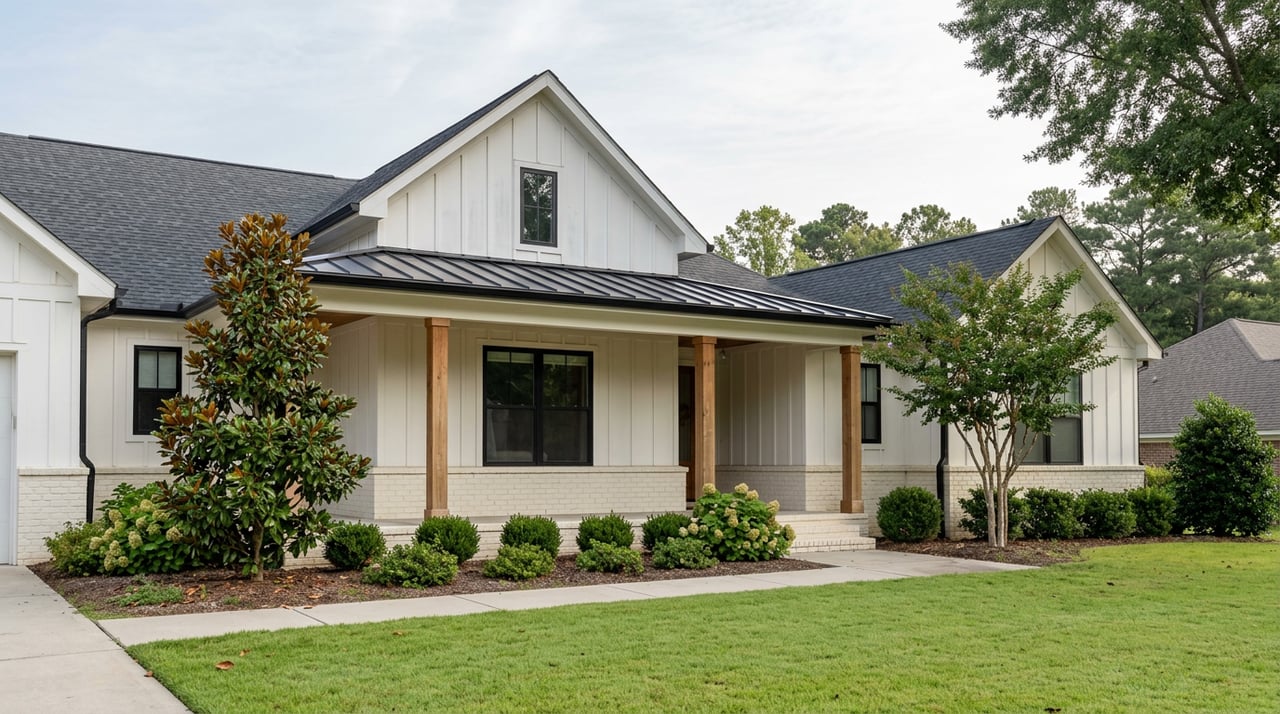
Picture two listings a few miles apart in Garner, both priced at $400,000, both roughly the same square footage. One sits inside the town's official limits. The other sits just across an invisible line in Wake County's unincorporated area, still served by Garner's schools and still close enough to walk to the same White Oak Crossing shopping center. On paper, they look identical. On a mortgage statement, they are not. One of these buyers will pay meaningfully more in property taxes every single year, and the listing photos will never tell them why.
That gap is the piece of the Garner story that gets lost when buyers compare median prices across Wake County suburbs. The town has earned its reputation as the value play south of Raleigh. It has also quietly become the most expensive place in Wake County to own that value, on a tax-rate basis. Both things are true, and understanding how they fit together is the difference between comparing list prices and comparing what you'll actually pay each month.
The Number Every Portal Leads With
The headline is accurate as far as it goes. Over the three months ending May 2026, Garner's median sale price per square foot sat at $183, down 8.5% year over year, which puts it below the going rate in Cary, Apex, and Holly Springs. Over that same window, the median sale price landed at $397,000, essentially flat compared to a year earlier.
Set that against the broader region. Wake County's countywide median sale price reached $490,400 in June 2026, and the Triangle-wide median hit $424,900 that same month. Garner is running below both benchmarks, which is exactly why it keeps showing up on lists of the region's best-value suburbs.
Part of what keeps that number low is supply. A large share of Garner's active inventory, roughly two in five listings, is new construction, concentrated in a handful of corridors: the White Oak Crossing and NC-42 area, the Cleveland Road and US-70 stretch, and the Timber Drive interchange near I-40. Communities like Georgia's Landing, Auburn Village, and Magnolia Park have been absorbing a steady stream of production-builder inventory, and that new supply keeps median prices from drifting toward the ceiling you'd find in Cary or Apex, where land is scarcer and new construction has shifted toward higher price points.
None of that is the whole picture. The price per square foot tells you what the house costs. It does not tell you what the house costs to own.
Where That Price Comes From
Garner's affordability and its growth are the same story told two ways. The town added nearly 5,000 residents between 2023 and 2024, a growth rate over 10%, which the town's own economic development office notes puts Garner 10th nationally for population growth among communities over 20,000 residents, based on U.S. Census Bureau data.
That growth did not arrive quietly. Amazon's robotic sorting facility on Jones Sausage Road, originally announced in 2018 as a 1,500-job project, has since doubled to roughly 3,000 employees. Nearby, the Eastern Wake Innovation Park is bringing new office and light-industrial space to a site adjacent to White Oak Crossing, positioned as a gateway between the shopping corridor and Garner's downtown, which has been in the middle of its own revitalization with new restaurants, a coffee roaster, and a recreation center.
Roads, schools, and public safety for that many new residents and that much new commercial square footage cost money, and property taxes are how a town like Garner pays for it. That is the honest context behind the number in the next section. It is not a red flag. It is the bill for the growth that makes the corridor attractive in the first place.
The Rate the Listing Photo Never Shows
For fiscal year 2026-27, Triangle Tax Map's compiled rate data shows Garner's combined municipal and county property tax rate at $1.0721 per $100 of assessed value, the highest of any major Wake County town:
| Town | Combined Rate (FY2026-27, per $100 assessed value) |
|---|---|
| Holly Springs | $0.8806 |
| Cary | $0.9046 |
| Raleigh | $0.9091 |
| Apex | $0.9106 |
| Fuquay-Varina | $0.9151 |
| Wake Forest | $0.9571 |
| Garner | $1.0721 |
On a $400,000 assessed value, that difference between Garner and Holly Springs works out to roughly $766 a year, or about $64 a month, before you even factor in the property's actual purchase price versus its assessed value. It is not a dealbreaker. It is a number that belongs in the same spreadsheet as the price per square foot, not a separate conversation that happens after the offer is already written.
Town Limits or ETJ? The Line That Decides Your Bill
Here is the part most buyers never think to ask about until they see two tax estimates that do not match. Garner, like most North Carolina towns, maintains an extraterritorial jurisdiction, or ETJ, that extends up to three miles beyond its official corporate limits. The town's own planning department is direct about what that means for a tax bill:
"Since residents of the ETJ still procure most of their public services from Wake County, they are only required to pay County property taxes."
In other words, a property inside Garner's ETJ pays only the Wake County portion of the rate, not the town portion, even though it may share a mailing address, a school district, and a shopping center with a home three streets away that sits inside official town limits and pays both. Using Triangle Tax Map's figures, Wake County's unincorporated rate starts around $0.5371 per $100 for FY2026-27. On that same $400,000 assessed value, that's roughly $2,148 a year, compared to about $4,288 a year at Garner's full in-town rate. That's a difference of about $178 a month, purely based on which side of a jurisdictional line a house sits on.
That line is not moving anytime soon. House Bill 173 has passed the North Carolina General Assembly and freezes ETJ expansion across Wake County at its January 1, 2025 boundaries through the end of 2028. So whatever the map looks like today is the map you'll be working from for at least a few more years.
The good news is that this is one of the easiest things to verify before you write an offer, not after. Wake County's own GIS mapping tool lets you search any address and turn on a jurisdictions layer that shows exactly which side of the line a property sits on. It takes less time than reading a disclosure packet, and it changes your real monthly number more than most of the upgrades a buyer will negotiate over.
Why Days on Market Told Two Different Stories This Year
There is a second place where a single number misleads if you do not know the calendar behind it. Over the three months ending May 2026, the typical Garner home took 49 days to sell, up from 35 days the year before, a shift that looked like a market cooling off.
Then July 2026 told a faster story. Homes that closed that month sold in an average of 35 days, down from 37 days in July 2025, even as the median sale price eased to $385,000. That is not two different markets. It is the same market read at two different points in its yearly rhythm. Garner has a well-documented seasonal pattern where July tends to be the fastest and strongest month to sell, historically closing near list price with pending times well under a month. A spring listing that takes seven weeks to sell is not necessarily underperforming. It may just be a home that will close in the month the market is built to move fastest.
Reading Garner's Numbers Like You Live Here
Put together, the picture is more useful than either number alone. Garner's price per square foot is genuinely the best value proposition in Wake County, backed by a growth story that includes real employers and real new infrastructure. That same growth is exactly why the town carries the highest combined tax rate among its Wake County peers, and why two nearly identical listings a few miles apart can carry meaningfully different monthly costs depending on which side of the ETJ line they sit on.
Buyers who compare Garner to Cary, Apex, or Fuquay-Varina on price alone are doing half the math. The other half takes ten minutes on a county GIS map and changes the comparison in ways that are easy to miss and expensive to ignore.
If you're weighing a move into Garner, or trying to figure out how a specific address stacks up against a similar one in Holly Springs or Clayton once taxes and timing are factored in, that's exactly the kind of local math Rod Hudson works through with buyers every week. Request a Valuation & Design Consult and we'll run the full picture together, not just the sticker price.
Common Questions
Does every home in Garner pay the same property tax rate? No. Homes inside Garner's official town limits pay both the Town of Garner rate and the Wake County rate. Homes in Garner's extraterritorial jurisdiction, an area extending up to three miles beyond town limits, pay only the county portion.
How do I find out if a specific address is inside Garner's town limits or its ETJ? Wake County's tax and GIS records let you search an address directly and view its jurisdiction status. Always confirm before writing an offer, since the tax estimate on a listing sheet may not reflect the applicable rate.
Does the higher tax rate mean Garner is a worse value than Cary or Apex? Not on its own. Garner's price per square foot still runs below most of its Wake County peers as of mid-2026. The tax rate narrows that gap. Whether it closes it depends on the specific property, its assessed value, and whether it falls inside town limits or the ETJ.